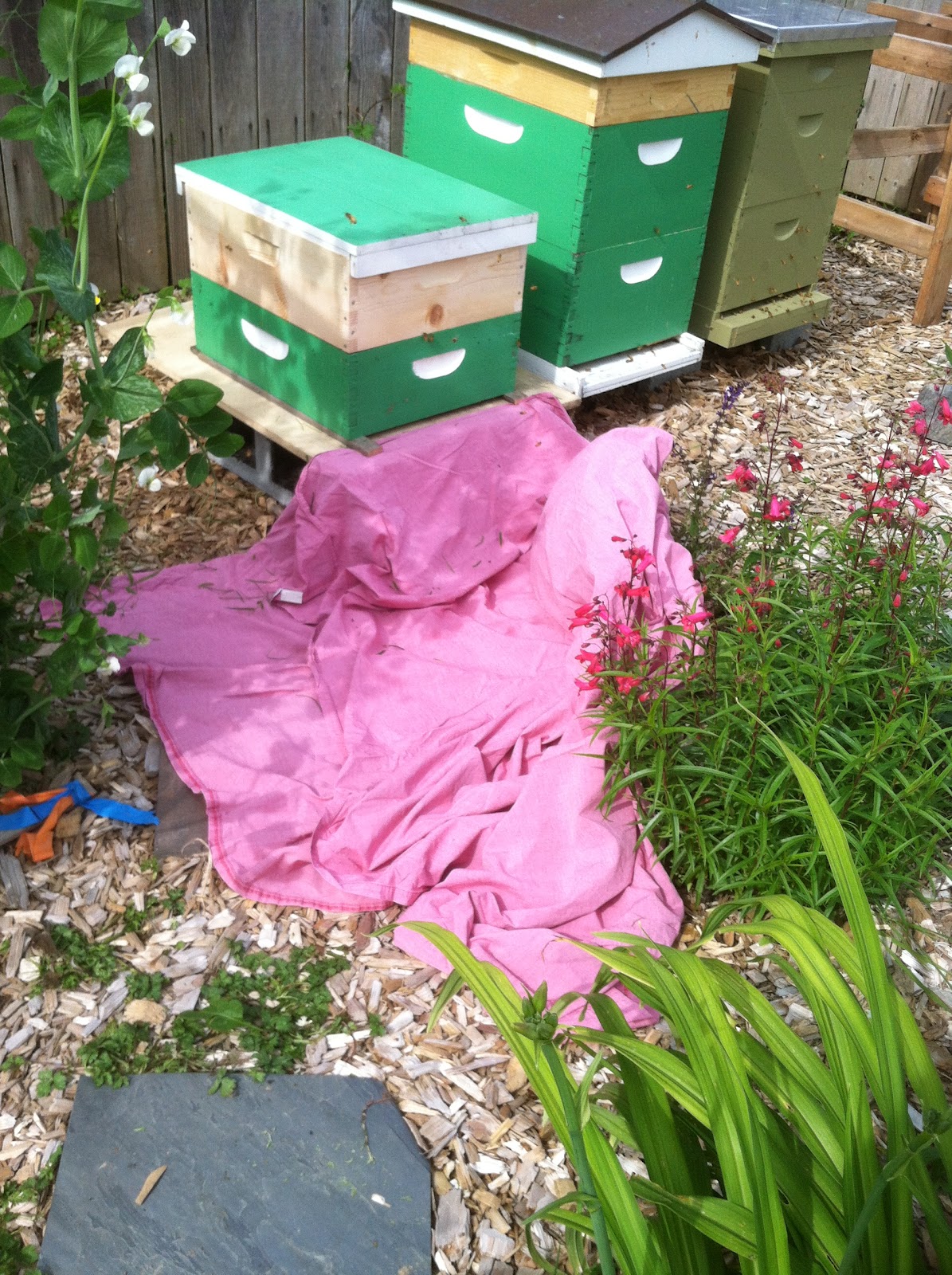
Matt was worried that his bees had brought in so much nectar and stored it in the brood chambers, that there was no room for the queen to lay her eggs. A beekeeper told us the term for that was "honey bound." He added another honey super (which made three) and hoped that the bees would move the food stores around so the queen would have more room to lay. He also took out one full deep frame that was full of capped honey and replaced it with an empty frame for them to draw out. He wrapped the frame in plastic wrap and put it in the freezer. This allows him to be able to feed this food to his bees this fall, while enabling them to have a new empty frame for more brood. Adding the third honey super worked out well because the bees did move lots of the nectar and pollen to make room down in the brood chamber.
The capped honey in the deep super that we put in the freezer. It was capped on both sides.
The bees cleaned the cells out to make room for brood.
We found out a way to get the bees to draw out the comb faster on the plastic frame. You melt some beeswax and using a foam brush, paint wax onto the frame. This just gives them a head start and encourages them to work on it.
With more wax painted on
Frame with plastic comb
The bees are really going after it and they have capped honey in the honey super too!
We also got some frame grippers. The frames are getting really heavy with all the nectar and bees! These help to hold the frame up with a bit less effort and awkwardness.
And here below is a great example of a tight brood pattern in the middle of the frame and and capped honey on the sides and top. This is how the bees and the queen organize the food and the larvae.
We decided not to check the hives this weekend, and just let the bees work. It has been humid lately and in the upper 70s, lower 80s. We noticed the bees loitering, especially Matt's, on what I will call the "porch" of the hive in the evening when they would normally be inside the hive. We found out that this behavior is called bearding. They do this when it is hot and humid and they need more ventilation. Matt added a honey super to help with crowding. He also drilled some wine cork sized holes so the bees would have another entrance and more air flow. As you can see, it does kind of look like a beard. Our is more like stubble compared to this first picture from http://www.sweetseattlelife.com (don't know these people, but they sound cool!)
It looks like we successfully managed the swarm hive. They had eaten away most of the newspaper and they have been working hard to build new comb. We are hoping that the queen will start laying eggs in the bottom of the hive because right now there is brood in the honey super. That couldn't be helped though considering that they swarmed and Matt had to put them into a new hive a.s.a.p. They looked good though and we decided to stop feeding the sugar syrup. Matt gave me a turn with the entrance feeder so they didn't have to quit the syrup cold turkey.
Himalayan Blackberry. Photo by Cheryl Moorehead
It has finally warmed up and stopped raining! It is the middle of the blackberry bloom which is a huge source of nectar for the bees. Nectar is what they use to make honey. When it is raining, the nectar washes away. We are crossing our fingers that the bees can still get enough nectar from the blackberries.
The bees crack me up when they cling together in chains like circus acrobats!
Matt's hive is doing well too. Matt did scrape off a queen cell. We only found that one, so hopefully the bees aren't getting any ideas . . . Matt also drilled a bee sized hole in his honey super so the bees could have another entrance and more ventilation. The picture was blurry so I will show it next time.
After my bees swarmed, and Matt called me at work to tell me, I got home and we tucked the bees in as best as we could and went to bed ourselves. Whew!
The Aftermath
As the week progressed, and we wondered what the bees were up to. Matt checked on the "old" hive, (the bees that stayed behind and didn't swarm) on Monday or Tuesday to see if there was any larvae or eggs. If the bees don't have any larvae to take care of, there is a risk that one of the workers could start laying eggs and that is not a good thing. So Matt scraped off any queen cells that he found, and kindly donated a frame of brood from his hive, so the bees would have some babies to take care of. While he was working the hive, he just happened to see a skinny little queen!
Usually, new queens are really hard to find because they are small. They need to be able to go out on a mating flight, and if they are too fat they can't fly. When a new queen hatches, she prepares for a mating flight or two, mates, and then comes back to the hive ready to lay eggs. We didn't know where she was in that cycle, but Matt made a quick executive decision to kill that new queen. Another option would have been to keep her and put her in a queen cage just in case we needed her. He also checked to see if my old queen was still with the swarm and she was.
This weekend, Matt's bees were super crabby! It might have been this crappy weather. We did a routine check of his hive and rotated some frames. We both got stung, Matt on the arm and me on the wrist. I guess they just didn't want to be messed with that day, but it's not as if we've had many nice days to pick from to check on them. Matt added an entrance feeder because it won't stop friggin' raining and the blackberry nectar is getting
all washed away.
Entrance Feeder
Can you find the Queen?
No honey yet!
We decided to combine my swarm hive and the old hive so I would have one stronger hive. To start, we checked the old hive and scraped off all the queen cells we could find. To combine the hives, you need to put a layer of newspaper in between them. The bees chew through it, and by the time they are done, they are used to the queen and they won't kill her. We cut slits in the newspaper to give the bees something to bite on to. Then we put the swarm hive on top.
Swarm hive
Some of the bees that were out foraging were confused at first, and didn't know where to go but they figured it out eventually. We put a screen bottom board on the tall hive so they could have good ventilation and crossed our fingers that the queen survives and that the bees get to work without any more drama. We will check on them next week to see how they are getting along. In the meantime, the peas from the garden are yummy and the blueberries are getting blue!
Sooo... Today was an exciting day in the Api-area! I (Matt) came home from work this afternoon, and as I was walking toward the back yard I heard the loudest bee-buzzing that I have heard to date. It was the warmest day since we got our bees and the population is the largest to date as well. As I walked toward the sound I considered those facts and hoped that it was the sound of many bees coming and going and hovering around the the hive. I was wrong! Kate's bees were swarming!!!!
As those of you who follow this blog may recall, we found swarm cells in Kate's hive on Saturday. We believed we had removed all of them after locating her queen. The thousands of bees that I found flying around the yard were evidence that we had not. When bees swarm, 50% or more of the colony leaves the hive with the original queen, while the rest stay and continue in their work with a new queen that they have raised.
I am not sure when the bees left the hive, but I am assuming it was just before I arrived at the house. How fortunate! When I walked into the yard I saw all of the bees flying around overhead. It was a giant cloud of bees! I immediately took Ethel (the dog) inside, threw my stuff down and went outside to assess the situation.
Sorry about the shaky video!
When bees swarm they leave the hive and fly off to an area where they can gather in a cluster around the queen while some of the bees go off in search of a new hive location. There is no way to tell where the bees will land and form that cluster. As I watched them all flying over the yard, I was begging them not to go far. I had visions of jumping in the truck and trying to follow them as they flew over houses and trees, the highway and the river. Thankfully that was not necessary.
See the bees up there in the upper half of the picture?
As I watch them I noticed some of the bees landing in the hibiscus tree in our yard about 25 feet from the hive they just left. More and more of the bees landed in the tree and they clustered together over several small branches. We got lucky. Now all I had to do was to teach myself how to capture and hive a swarm of bees, and execute those steps before they could fly off and continue their search. I only had time to check one (portable) reference so I grabbed our copy of "Beekeeping for Dummies" ( which I certainly felt fit our situation) and headed back out to the yard for some T.C.B.ing (taking care of business).
I needed to do five things: 1) find a box 2) get the bees into the box 3) prepare a new hive for the swarm 4) find and lay out a sheet in front of the new hive, making a ramp up to the entrance of said hive, and 5) shake the bees out onto the blanket and at/on the entrance hoping they find the new home acceptable. Easier said than done. At least in this situation.
Many beekeepers are prepared to capture a swarm and have the necessary equipment at the ready. In fact, for a beekeeper looking to expand their operation a swarm is a blessing. It is a healthy colony looking for a new home. Being in our first season of beekeeping and planning to keep only two hives, we have not prepared ourselves for this. What's a boy to do? Adapt, improvise, and overcome!
I scrambled around for a box. I found a box that would work, but after I emptied it out I realized that the bottom was jacked up and in need of tape. I ran inside with the box, grabbed a roll of packing tape, made
one pass across the bottom with the tape, and ran out of tape. WAH, wah... I quickly found another roll of tape and sealed off the bottom and went on to step two.
My intention was to climb up the ladder with the box, cut off the branches that the swarm was hanging on and place them in the box. Unfortunately they were on several small branches and as I took hold to cut them off the bees began falling off the branches into the box. I decided to go with it and I shook all of the branches I could reach and "shake" them off into the boxes. FYI, "shaking" bees is an actual technique. True story (for those of you who watched the video of me hiving my package bees). I think this is a good time to note that with only a veil on, and bare arms and hands I was not stung even once. Swarming bees look alarming but they are at their most gentle when seeking with out a hive to defend. In fact, I do not wear gloves when working my hive and through nine hive inspections have only been stung once by a bee that I carelessly pinched between my thumb and a frame. I quickly climbed down the ladder and closed up the box. Almost. The top of the box was jacked up just like the bottom so it wouldn't close tightly. So I grabbed a shirt that had been in the box and draped it over the top hoping it would keep the bees in. But I did not get all of the swarm because I could not reach them. I grabbed another smaller box and returned up the ladder to snip off the branches with the remaining bees. I started snipping from the bottom and realized that I needed a new system. I placed the cut branches with the bees in the box and went forward with a new approach. I started by snipping a branch from the top and stacking it on the next lower branch, cutting that branch and stacking them on the next, and so on. That worked out well. I snipped the largest branch last, opened and added them to the box, and closed it up. Again, almost. The shirt didn't quite do it so I covered the box with two old rugs that had been relegated to outdoor service. Phew, that was intense!
Matt collected the bees in this box, putting odds and ends over the top so they wouldn't fly out.
Now for the new home. Like I said, we do not have a lot of extra equipment handy to accommodate a new hive so I had to improvise. Normally you'd hive them in a deep box but we do not have any extra. We do have western honey supers. I filled two with frames and stacked them, added an outer cover and was ready to go. NOT SO FAST! We only have two bottom boards. I found a piece of plywood to set the boxes on but that would leave no entrance for the bees. Improvise! I grabbed a couple of wooden stakes and a hand saw and cut pieces to sit under three sides of the westerns, allowing for and entrance that mimicked that of a proper bottom board! Overcome!
The bees will use the sheet as a ramp
I found the sheet that I thought would least upset Hunny for use as a collector and ramp. I added a couple pieces of alder for extra ramps and went for it. I shook the bees like I never shook bees before. I shook the small branches over the entrance and the box onto the sheet. Many of the bees began marching in, and some of the bees remained at the entrance "fanning", sending a locating scent to the rest of the swarm. More and more moved into the hive, but many were clinging to the underside of the alder. I was worried that if I left them they may not move in so I shook the boards onto the sheet near the entrance. Most of the bees went right in. Within a half hour all of the bees had moved into the new hive.
After Kate got home we added a feeder inside two empty western super boxes on top of my inner cover (not currently in use) and put them to bed.
The lids have tiny holes in them so the bees can drink.
Where Matt put the swarm. (Two honey supers with frames)
feeding the swarm with a different kind of top feeder
Close up the swarm!
That was very intense. Handling the swarm was a very unique and awesome experience. It was something greater that the normal bee handling that occurs during hive inspection. To experience them acting as one organism was incredibly real, and handling them in such a gentle state has only served to strengthen my bond (if you can call it that) to the bees. I am so glad that we are keeping bees, and am looking forward to the next challenge and opportunity to understand and connect with these amazing insects. They are far more forgiving than I anticipated. There are many threats to domesticated honeybees in north america. We will do our best to protect our colonies, and hope that out bees will forgive and absorb our inevitable missteps.
Our intention is to keep only two hives. Therefore we will recombine Kate's colonies in about one week's time. Stay tuned, as that will be another interesting and exciting experience that we are looking forward to sharing with all of you, our friends.
Ok. Good news. So Matt talked to Jim from Beez Knees Apiary Supply where we took our bee classes. He said that he thinks the bees got caught outside and got disoriented when it was too cold. They can't fly when it is too cold. It looks like Jim was right.They looked dead the next morning when I left for work. When Matt went to check on them when he got home from work, They were moving. He scooped some of them up and put them near the entrance and they crawled in. The sun came out for a couple of minutes and when Matt went back out there a bit later, they were all gone! They huddled together to keep warm and survive. A rainy night and a day clinging to the rock and the wood chips, and then they went back into the hive when they warmed up! They huddled together to stay warm, and not die and it worked.
This may have been a classic case of "new motherhood." It is easy to worry about our new bees. We are so much as we go. They did look dead and dying though. Whew! The bees probably aren't dying of tracheal mites!
Normally I just write once a week when we check the hives, you know, no use in cluttering up the blogosphere right? But there is something wrong going on at Matt's hive. When he came home today there were clusters of bees on the ground outside his hive. They aren't moving and they look like they may be dying. When I came home from work I saw them too. We think it may be tracheal mites. But it could be a gut disease called nosema, there are signs of that too. Both issues have similar symptoms. I don't know!
Ugghhh! I hate tracheal mites. As I mentioned a couple of entries ago, tracheal mites live in the breathing tubes of the bees, the trachea. Having an inhaler myself, and having had breathing problems of my own before, I can't bear the idea of the bees having a hard time breathing, let alone suffocating to death from mites living in their trachea. It breaks my heart. As I shake my fist in the air, CURSE YOU TRACHEAL MITES! I know all beings have intrinsic value, but come on, don't kill our innocent bees.
We began treating for tracheal mites this weekend with grease patties, thinking that we were ahead of the game. Maybe we weren't. We will see what happens tomorrow I guess. Sigh.